 Kotlinv2.4INTERMEDIATE
Kotlin
Kotlin cheat sheet covering syntax, null safety, coroutines, data classes, extensions, and Android development patterns with examples.
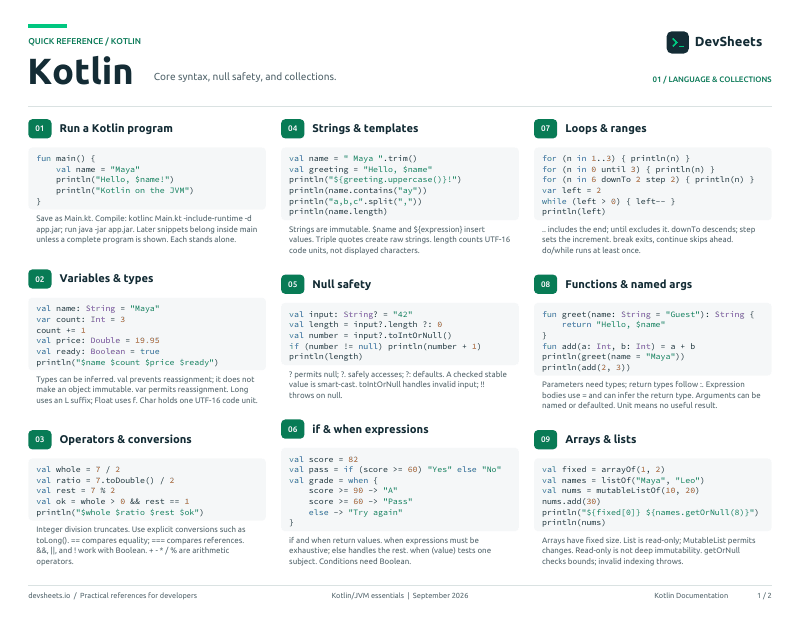
PDF · 2 pages
Kotlin PDF cheat sheet
A two-page Kotlin reference for printing or offline use.
Setup
Install the Kotlin compiler and run a small JVM application.
Install Kotlin with SDKMAN or Homebrew, verify it, and build a JAR.
# macOS or Linux with SDKMAN
curl -s "https://get.sdkman.io" | bash
source "$HOME/.sdkman/bin/sdkman-init.sh"
sdk install java
sdk install kotlin

# macOS with Homebrew
brew install kotlinGetting Started
Kotlin basics and fundamentals
Variable declarations and basic types
// Immutable variable (read-only)
val name: String = "Kotlin"
val age = 25  // Type inference
// name = "Java"  // Error: Val cannot be reassigned

// Mutable variable
var count = 0
count++  // OK
count = 10  // OK

// Basic types
val byte: Byte = 127
val short: Short = 32767
val int: Int = 2147483647
val long: Long = 9223372036854775807L
val float: Float = 3.14f
val double: Double = 3.141592653589793
val boolean: Boolean = true
val char: Char = 'K'
val string: String = "Hello, Kotlin"String interpolation and manipulation
// String templates
val name = "Alice"
val age = 30
val message = "Hello, $name! You are $age years old."
val expression = "Next year you'll be ${age + 1}"

// Multiline strings
val multiline = """
    |First line
    |Second line
    |Third line
    """.trimMargin()

val rawString = """
    No escaping needed:
 	 \
    Preserves formatting
"""

// String operations
val str = "Kotlin"
println(str.length)  // 6
println(str.uppercase())  // KOTLIN
println(str[0])  // K
println(str.substring(0, 3)) // KotNull Safety
Kotlin null safety system
Working with nullable types safely
// Nullable types
var nullable: String? = "Hello"
nullable = null  // OK

var nonNull: String = "Hello"
// nonNull = null  // Error: Null cannot be assigned

// Safe call operator
val length = nullable?.length  // Returns null if nullable is null

// Elvis operator
val lengthOrZero = nullable?.length ?: 0
val message = nullable ?: "Default message"

// Not-null assertion (use sparingly!)
val forceLength = nullable!!.length  // Throws NPE if null

// Safe casts
val any: Any = "String"
val str: String? = any as? String  // Safe cast
val num: Int? = any as? Int // Returns nullAdvanced null handling patterns
// Scoped functions for null handling
val str: String? = "Hello"

// let - execute block if not null
str?.let {
    println("Length: ${it.length}")
}

// also - side effects
str?.also {
    println("Processing: $it")
}?.uppercase()

// run - execute block with receiver
val result = str?.run {
    println("Running on $this")
    length * 2
}

// takeIf / takeUnless
val email = "user@example.com"
val validEmail = email.takeIf { it.contains("@") }
val invalidEmail = email.takeUnless { it.contains("@") }Functions
Function declarations and features
Function syntax and parameters
// Basic function
fun greet(name: String): String {
    return "Hello, $name!"
}

// Single expression function
fun add(a: Int, b: Int) = a + b

// Default parameters
fun connect(host: String = "localhost", port: Int = 8080) {
    println("Connecting to $host:$port")
}

// Named arguments
connect(port = 3000, host = "example.com")

// Unit return type (void)
fun printMessage(msg: String): Unit {
    println(msg)
}
// Unit can be omitted
fun log(msg: String) {
    println("[LOG] $msg")
}Functions as parameters and lambdas
// Lambda expressions
val sum = { x: Int, y: Int -> x + y }
val square: (Int) -> Int = { it * it }

// Higher-order function
fun calculate(x: Int, y: Int, operation: (Int, Int) -> Int): Int {
    return operation(x, y)
}

val result = calculate(10, 5) { a, b -> a * b }

// Function with receiver
fun buildString(action: StringBuilder.() -> Unit): String {
    val sb = StringBuilder()
    sb.action()
    return sb.toString()
}

val html = buildString {
    append("<h1>")
    append("Title")
    append("</h1>")
}

// Inline functions
inline fun measureTime(block: () -> Unit): Long {
    val start = System.currentTimeMillis()
    block()
    return System.currentTimeMillis() - start
}Classes & Objects
Object-oriented programming in Kotlin
Class declarations and constructors
// Primary constructor
class Person(val name: String, var age: Int)

// Full syntax with init block
class Student(firstName: String, lastName: String) {
    val fullName: String
    var grade: Int = 0

    init {
        fullName = "$firstName $lastName"
        println("Student created: $fullName")
    }

    // Secondary constructor
    constructor(name: String) : this(name, "") {
        println("Secondary constructor called")
    }
}

// Properties with getters/setters
class Temperature {
    var celsius: Double = 0.0
        get() = field
        set(value) {
            field = if (value < -273.15) -273.15 else value
        }

    val fahrenheit: Double
        get() = celsius * 9/5 + 32
}Class inheritance and polymorphism
// Open class (can be inherited)
open class Animal(val name: String) {
    open fun makeSound() {
        println("Some generic animal sound")
    }

    fun sleep() {
        println("$name is sleeping")
    }
}

// Inheritance
class Dog(name: String, val breed: String) : Animal(name) {
    override fun makeSound() {
        println("$name barks: Woof!")
    }

    fun wagTail() {
        println("$name is wagging tail")
    }
}

// Abstract classes
abstract class Shape {
    abstract val area: Double
    abstract fun draw()

    fun describe() {
        println("Area: $area")
    }
}

class Circle(private val radius: Double) : Shape() {
    override val area = Math.PI * radius * radius

    override fun draw() {
        println("Drawing circle with radius $radius")
    }
}Data Classes & Objects
Data classes, objects, and companions
Classes for holding data
// Data class
data class User(
    val id: Int,
    val name: String,
    var email: String
)

val user = User(1, "Alice", "alice@example.com")
val copy = user.copy(email = "newemail@example.com")

// Destructuring
val (id, name, email) = user

// Generated methods
println(user.toString())  // User(id=1, name=Alice, email=alice@example.com)
println(user.hashCode())
println(user == copy)  // false (different email)

// Data class requirements
// - Primary constructor with at least one parameter
// - All parameters marked as val or var
// - Cannot be abstract, open, sealed, or innerSingleton objects and companion objects
// Object declaration (Singleton)
object DatabaseConnection {
    init {
        println("Initializing database connection")
    }

    fun connect() {
        println("Connecting to database...")
    }
}

// Usage
DatabaseConnection.connect()

// Companion object
class Factory {
    companion object {
        private var counter = 0

        fun create(): Factory {
            counter++
            return Factory()
        }

        fun getCount() = counter
    }
}

val instance = Factory.create()
val count = Factory.getCount()

// Named companion
class MyClass {
    companion object Loader {
        fun load() = MyClass()
    }
}Collections
Lists, Sets, Maps and operations
Lists, Sets, and Maps
// Immutable collections
val list = listOf(1, 2, 3)
val set = setOf("a", "b", "c")
val map = mapOf("key1" to "value1", "key2" to "value2")

// Mutable collections
val mutableList = mutableListOf(1, 2, 3)
mutableList.add(4)
mutableList.removeAt(0)

val mutableSet = mutableSetOf("a", "b")
mutableSet.add("c")

val mutableMap = mutableMapOf<String, Int>()
mutableMap["one"] = 1
mutableMap["two"] = 2

// Array types
val intArray = intArrayOf(1, 2, 3)
val stringArray = arrayOf("a", "b", "c")
val nullArray = arrayOfNulls<String>(5)Transformations and aggregations
// Transformations
val numbers = listOf(1, 2, 3, 4, 5)
val doubled = numbers.map { it * 2 }
val filtered = numbers.filter { it > 2 }
val strings = numbers.map { "Item $it" }

// Aggregations
val sum = numbers.sum()
val average = numbers.average()
val max = numbers.maxOrNull()
val count = numbers.count { it % 2 == 0 }

// Grouping
val words = listOf("apple", "apricot", "banana", "blueberry")
val grouped = words.groupBy { it.first() }
// {a=[apple, apricot], b=[banana, blueberry]}

// Flattening
val nested = listOf(listOf(1, 2), listOf(3, 4))
val flat = nested.flatten()  // [1, 2, 3, 4]
val flatMapped = nested.flatMap { it.map { n -> n * 2 } } // [2, 4, 6, 8]Control Flow
Conditionals and loops
if, when, and conditional expressions
// If expression
val max = if (a > b) a else b

// If-else chain
val result = if (score >= 90) {
    "A"
} else if (score >= 80) {
    "B"
} else if (score >= 70) {
    "C"
} else {
    "F"
}

// When expression (like switch)
when (x) {
    1 -> println("One")
    2 -> println("Two")
    3, 4 -> println("Three or Four")
    in 5..10 -> println("Between 5 and 10")
    !in 10..20 -> println("Not between 10 and 20")
    is String -> println("It's a string")
    else -> println("Unknown")
}

// When as expression
val description = when (val code = getCode()) {
    200 -> "OK"
    404 -> "Not Found"
    500 -> "Server Error"
    else -> "Unknown code: $code"
}for, while, and loop control
// For loops
for (i in 1..5) {
    println(i)  // 1, 2, 3, 4, 5
}

for (i in 1 until 5) {
    println(i)  // 1, 2, 3, 4
}

for (i in 5 downTo 1) {
    println(i)  // 5, 4, 3, 2, 1
}

for (i in 1..10 step 2) {
    println(i)  // 1, 3, 5, 7, 9
}

// Iterating collections
val list = listOf("a", "b", "c")
for (item in list) {
    println(item)
}

for ((index, value) in list.withIndex()) {
    println("$index: $value")
}

// While loops
var x = 5
while (x > 0) {
    println(x--)
}

// Do-while
do {
    val y = readLine()
} while (y != "exit")Extensions
Extension functions and properties
Adding functions to existing types
// Extension function
fun String.removeSpaces(): String {
    return this.replace(" ", "")
}

val text = "Hello World"
println(text.removeSpaces())  // HelloWorld

// Extension properties
val String.lastChar: Char
    get() = this[length - 1]

println("Kotlin".lastChar)  // n

// Extensions on nullable types
fun String?.isNullOrEmpty(): Boolean {
    return this == null || this.isEmpty()
}

val nullString: String? = null
println(nullString.isNullOrEmpty())  // true

// Generic extensions
fun <T> List<T>.secondOrNull(): T? {
    return if (size >= 2) this[1] else null
}let, run, with, apply, also
// let - it as argument, returns result
val result = "Hello".let {
    println("Original: $it")
    it.uppercase()
}  // HELLO

// Null safety with let
val nullableString: String? = "Kotlin"
nullableString?.let {
    println("Length: ${it.length}")
}

// run - this as receiver, returns result
val formatted = "hello".run {
    println("Original: $this")
    uppercase()
}  // HELLO

// with - non-extension, returns result
val numbers = mutableListOf(1, 2, 3)
val sum = with(numbers) {
    add(4)
    add(5)
    sum()
}

// apply - this as receiver, returns receiver
val person = Person().apply {
    name = "Alice"
    age = 30
    email = "alice@example.com"
}

// also - it as argument, returns receiver
val list = mutableListOf(1, 2, 3).also {
    println("Adding items to list: $it")
    it.add(4)
}Coroutines
Asynchronous programming with coroutines
Launching and managing coroutines
// Coroutine scope and launch
import kotlinx.coroutines.*

fun main() = runBlocking {
    launch {
        delay(1000)
        println("World")
    }
    println("Hello")
}

// Async and await
suspend fun fetchUser(): User {
    delay(1000)  // Simulated network call
    return User("Alice")
}

suspend fun fetchPosts(): List<Post> {
    delay(1000)
    return listOf(Post("Title"))
}

fun main() = runBlocking {
    val user = async { fetchUser() }
    val posts = async { fetchPosts() }

    println("User: ${user.await()}")
    println("Posts: ${posts.await()}")
}

// Suspend functions
suspend fun doWork() {
    delay(1000)
    println("Work done")
}Dispatchers and coroutine context
// Dispatchers
fun main() = runBlocking {
    launch(Dispatchers.Main) {
        // UI updates (Android)
    }

    launch(Dispatchers.IO) {
        // IO operations
        val data = readFile()
    }

    launch(Dispatchers.Default) {
        // CPU-intensive work
        val result = complexCalculation()
    }

    launch(Dispatchers.Unconfined) {
        // Not confined to any thread
    }
}

// withContext - switching context
suspend fun fetchData(): String = withContext(Dispatchers.IO) {
    // Perform IO operation
    readFromNetwork()
}

suspend fun processData() = withContext(Dispatchers.Default) {
    // CPU-intensive processing
    parseData()
}

// Flow - cold asynchronous stream
fun numbersFlow(): Flow<Int> = flow {
    for (i in 1..5) {
        delay(100)
        emit(i)
    }
}

fun main() = runBlocking {
    numbersFlow()
        .map { it * it }
        .filter { it % 2 == 0 }
        .collect { println(it) }
}Generics
Generic types and variance
Type parameters and constraints
// Generic class
class Box<T>(val value: T) {
    fun get(): T = value
}

val intBox = Box(42)
val stringBox = Box("Hello")

// Generic function
fun <T> singletonList(item: T): List<T> {
    return listOf(item)
}

val list = singletonList("item")

// Multiple type parameters
class Pair<A, B>(val first: A, val second: B) {
    fun swap(): Pair<B, A> = Pair(second, first)
}

// Type constraints
fun <T : Comparable<T>> max(a: T, b: T): T {
    return if (a > b) a else b
}

// Multiple constraints with where
fun <T> process(value: T)
    where T : CharSequence,
          T : Comparable<T> {
    println("Length: ${value.length}")
    println("Value: $value")
}Delegation
Class and property delegation
Class delegation and delegated properties
// Class delegation
interface Base {
    fun print()
    val message: String
}

class BaseImpl(val x: Int) : Base {
    override fun print() = println(x)
    override val message = "BaseImpl: $x"
}

class Derived(b: Base) : Base by b {
    // Can override members
    override val message = "Derived message"
}

val base = BaseImpl(10)
val derived = Derived(base)
derived.print()  // Delegates to base

// Delegated properties
class User {
    // Lazy property
    val lazyValue: String by lazy {
        println("Computing lazy value")
        "Hello"
    }

    // Observable property
    var name: String by Delegates.observable("Initial") {
        prop, old, new ->
        println("$old -> $new")
    }

    // Vetoable property
    var age: Int by Delegates.vetoable(0) {
        prop, old, new ->
        new >= 0  // Reject negative values
    }
}DSL Building
Creating domain-specific languages
Building type-safe DSLs
// HTML DSL example
class HTML {
    private val children = mutableListOf<Element>()

    fun body(init: Body.() -> Unit) {
        val body = Body()
        body.init()
        children.add(body)
    }
}

class Body : Element() {
    fun h1(text: String, init: H1.() -> Unit = {}) {
        val h1 = H1(text)
        h1.init()
        children.add(h1)
    }

    fun p(text: String) {
        children.add(P(text))
    }
}

fun html(init: HTML.() -> Unit): HTML {
    val html = HTML()
    html.init()
    return html
}

// Usage
val doc = html {
    body {
        h1("Title") {
            // H1 configuration
        }
        p("Paragraph text")
    }
}Annotations & Reflection
Custom annotations and reflection
Creating and using annotations
// Annotation declaration
@Target(AnnotationTarget.CLASS, AnnotationTarget.FUNCTION)
@Retention(AnnotationRetention.RUNTIME)
@MustBeDocumented
annotation class MyAnnotation(
    val name: String,
    val version: Int = 1
)

// Using annotations
@MyAnnotation(name = "Example", version = 2)
class AnnotatedClass {
    @Deprecated("Use newMethod instead")
    fun oldMethod() {}

    @JvmStatic
    fun staticMethod() {}

    @Throws(IOException::class)
    fun riskyMethod() {
        throw IOException("Error")
    }
}

// Built-in annotations
class Example {
    @JvmField
    val field = "Public field in Java"

    @JvmOverloads
    fun method(a: String = "default") {}

    @Suppress("UNCHECKED_CAST")
    fun uncheckedCast(obj: Any): List<String> {
        return obj as List<String>
    }
}Interoperability
Java interop and platform types
Calling Java from Kotlin and vice versa
// Calling Java from Kotlin
val list = ArrayList<String>()  // Java class
list.add("item")
list.remove("item")

// Platform types
val item = list[0]  // Platform type String!
// Can be treated as nullable or non-null
val nullable: String? = item
val nonNull: String = item  // May throw NPE

// Java getters/setters as properties
// Java: class Person { getName(); setName(String) }
val person = Person()
person.name = "Alice"  // Calls setName
val name = person.name  // Calls getName

// Static members
val result = Math.max(5, 10)  // Java static method
val pi = Math.PI  // Java static field

// SAM conversion
val runnable = Runnable {
    println("Running")
}

button.setOnClickListener { view ->
    // SAM conversion for Java interfaces
}Advanced Features
Inline classes, contracts, and more
Performance optimizations
// Inline functions
inline fun measureTimeMillis(block: () -> Unit): Long {
    val start = System.currentTimeMillis()
    block()
    return System.currentTimeMillis() - start
}

// No function call overhead
val time = measureTimeMillis {
    // Code is inlined here
    Thread.sleep(100)
}

// Inline classes (value classes)
@JvmInline
value class UserId(val id: Long) {
    init {
        require(id > 0) { "Id must be positive" }
    }

    val displayId: String
        get() = "USER_$id"
}

// No boxing overhead at runtime
fun getUser(userId: UserId) {
    // userId is passed as primitive long
}

// Crossinline and noinline
inline fun inlineFunc(
    crossinline body: () -> Unit,  // Can't use return
    noinline callback: () -> Unit   // Not inlined
) {
    val runnable = object : Runnable {
        override fun run() {
            body()  // OK with crossinline
        }
    }
    callback()  // Regular function call
}